




Nd:YLF – Neodymium doped yttrium lithium fluoride
Absorption range 790-810 nm | Emission 1047, 1053, 1313, 1324, 1370 nm
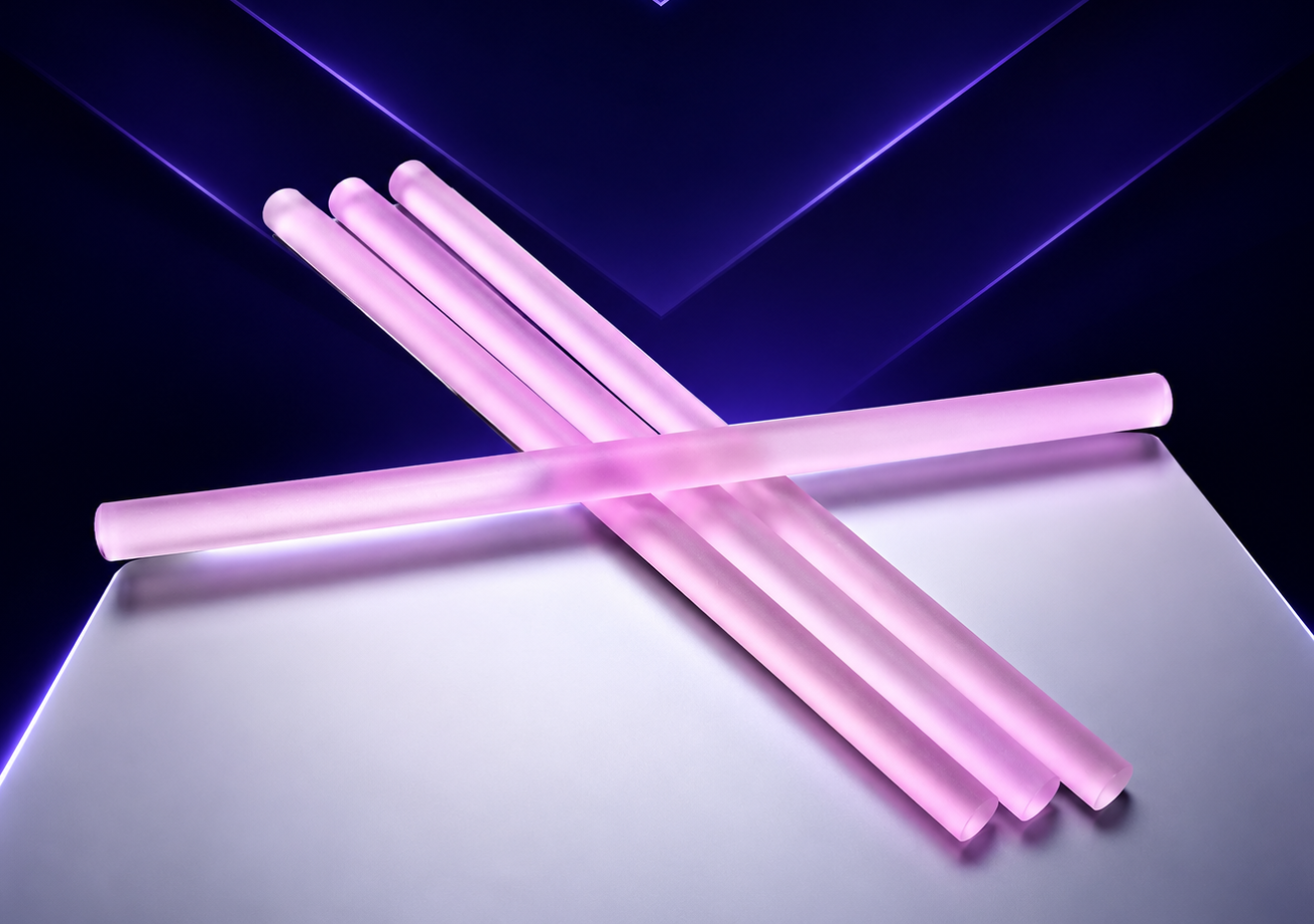
Nd:YLF crystal (Neodymium-doped yttrium lithium fluoride, or Nd:LiYF4) is popular gain material for solid state lasers. And great substitute of Nd:YAG crystal.
Nd:YLF crystal pumping(absorption)
Since Nd:YLF crystal’s absorption range is 790-810 nm, it can be very easily pumped by using 808 nm diode for diode-pumping. However, Nd:YLF laser can also be lamp-pumped.
Nd:YLF crystal emission (lasing)
Both emission wavelengths of Neodymium-doped YLF (Nd:YLF) depends on polarization. 3photon can offer:
- 1047 nm (strongest lasing peak) has π polarization (a-axis)
- 1053 nm (lasing peak) is for σ polarization (c-axis)
Nd:YLF is sometimes preferred substitute for Nd:YAG crystal
Which is better Nd:YLF or Nd:YAG?
Main advantages of Nd:YLF over Nd:YAG
When repetition rate is low (less than few kilohertz), Nd:YLF is more suitable to get higher pulse energy than Nd:YAG. Nd:YLF has lower thermal conductivity, but still exhibits lesser thermal distortions.
Main disadvantages of Nd:YLF over Nd:YAG
However, main disadvantages over Nd:YAG is that Nd:YLF is much more soft and brittle and it is a little bit sensitive to water.
YLF doping with other materials
Yttrium lithium fluoride (YLF) crystals can also be doped with other rare earth materials. E.g. with:
Praseodymium (Pr) – Pr:YLF, Erbium (Er) – Er:YLF, Holmium (Ho) – Ho:YLF, Thulium (Tm), – Tm:YLF, Ytterbium (Yb) – Yb:YLF
- Features
Emission lines at 1.05 μm and 1.32 μm and 1.37 μm (1047 nm, 1053 nm, 1313 nm, 1324 nm, 1370 nm)
Absorption range is 790-810 nm (0.8 μm)
Wide fluorescence width
Weak thermal lensing effect
Oscillation is naturally polarized
Material is brittle and soft 3photon suggest careful handling, due to fragility of Nd:YLF material.
Nd:YLF crystal material is sensitive to moisture (soluble in water) and may dissolve after long continued exposure to water for example during the cooling with liquids.
- Applications
Nd:YLF can be used as a material for
- Continues-wave (CW) lasers
- mode-locking operations
- Q-Switching at low-medium repetition rates.
Neodymium doped YLF other applications include pumping:
- Lasers used in ultra-fast amplifiers in low-medium repetition rates (<5 kilohertz)
- Femtosecond (fs) Titan doped sapphire (Ti:Sapphire) chirped-pulse amplifiers
- Nd:Glass amplifiers (Nd:YLF is used in laser-generator or amplifier)
*Please share your desired specifications
Frequently Bought Products
Product Queries (0)
Login Or Registerto submit your questions to seller
Other Questions
No none asked to seller yet